
McDonald’s Achieves Sub-Second Analytics at Scale with TDengine
Overview
Faced with the challenge of managing and analyzing billions of server monitoring records each day, McDonald’s turned to TDengine to transform its time-series data infrastructure. The result: a high-performance, real-time analytics system capable of delivering sub-second insights, even on datasets containing tens of millions of records per table.
Customer Background
The system being monitored consisted of more than 800 servers that generate 3.5 billion data records per day, with some machines generating as many as 10 million data points daily. Storing and monitoring this dataset is critical to maintaining system reliability, ensuring optimal performance, and proactively identifying anomalies.
Business queries at McDonald’s rely heavily on percentile-based latency metrics, particularly determining the P90, P95, P99, and P99.99 of certain data. These metrics help the engineering and operations teams understand worst-case response times and deliver consistently smooth user experiences.
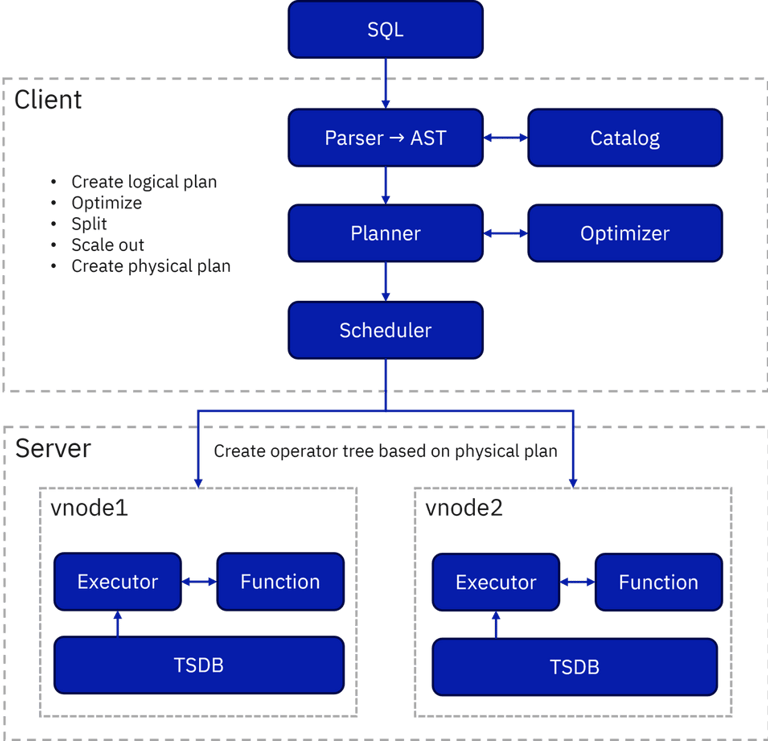
Query flow at McDonald’s
The Challenge
McDonald’s needed to:
Store and manage billions of time-series records per day
Query latency metrics across tens of millions of records, on-demand and in real time
Maintain query response times under 1 second, even for complex analytics involving multiple percentile calculations
Traditional approaches could not keep pace. Initial tests showed that computing multiple percentile values over a single table of 10 million rows took over 2.5 seconds, creating a bottleneck for operational visibility.
The TDengine Solution
TDengine worked closely with McDonald’s engineering team to redesign and optimize the execution of percentile-based queries. Key innovations included:
Multi-Percentile Optimization:
McDonald’s percentile queries targeted a single data column over a fixed time range. TDengine introduced merged histogram bucketing, which enabled multiple percentile values to be calculated in a single pass, eliminating redundant computations and significantly improving performance.Intelligent Use of Summary Statistics:
TDengine’s query planner was enhanced to leverage statistical moving averages (SMA) during the first scan of percentile queries. This reduced the need to load raw data in early computation stages, cutting total execution time without sacrificing accuracy.
Results
Query time reduced from 2.5 seconds to 0.8 seconds, even with simultaneous COUNT, AVG, and multiple PERCENTILE functions
Single-table queries over 10 million records consistently returned results in under one second
Enabled real-time monitoring and faster issue resolution across all monitored servers
Delivered greater operational agility by accelerating the feedback loop between performance data and decision-making
Why TDengine
Built for scale: Optimized for high-ingestion workloads and per-device isolation
Designed for performance: Engineered for millisecond-latency queries, even under heavy data volumes
Deep technical support: TDengine’s team provided hands-on engineering collaboration and custom query optimization
Conclusion
By partnering with TDengine, McDonald’s successfully transformed its server monitoring pipeline into a real-time analytics platform. The sub-second performance achieved through collaborative optimization work has allowed the company to unlock new levels of visibility, responsiveness, and confidence in its operations.
Note: This case study is originally published by TDengine. As an official partner, OpenDataTechs provides localized product sales, solution design, deployment and consulting services in EU and UK.
Products
TDengine AI-Powered Data Historian
© 2026 All rights reserved.
Company
BLOGS and NEWS
SOCIAL MEDIA